The Hosting Layout: Small Main-Floor Changes That Change Everything
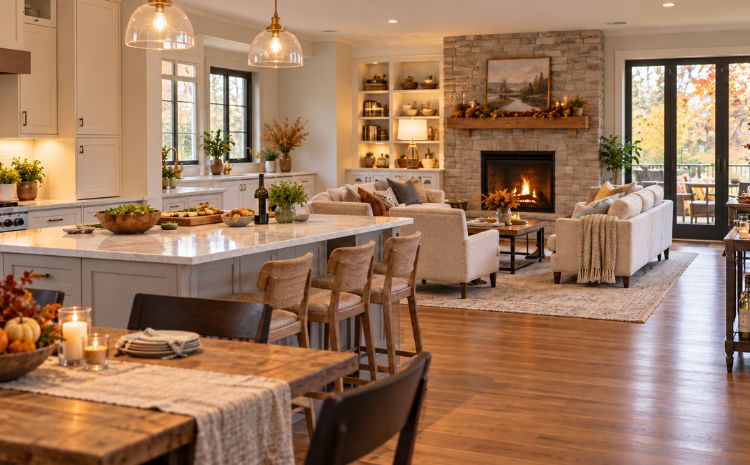
Nine days before the biggest hosting day of the year, let's name the real problem. When a main floor fails a party, it's almost never square footage — we've watched 1,600-square-foot houses host beautifully and 3,200-square-foot houses jam up like a bad intersection. What fails is flow: where people enter, where they cluster, what the cook can see, and where the drinks live relative to the doorway everyone's standing in.
The good news: flow problems have fixes at every budget, from furniture moves this weekend to one wall next spring. Here's how we diagnose a hosting layout, and the interventions in ascending order of commitment.
The Four Flow Failures (Find Yours)
The pinch point. Every party has a bar, a buffet, or a doorway where two people can't pass. Watch where apologetic shuffling happens — that's your bottleneck, and it's usually the drinks station parked in a traffic lane.
The isolated cook. Closed kitchen, host in it, party elsewhere — the layout problem that launched a thousand open concepts. The cook misses the party; the party migrates into the too-small kitchen anyway; everyone loses.
The orphaned room. The formal living or dining room that sits empty while forty people compress into the kitchen. Rooms without a sightline to the action don't get used — guests go where they can see people, period.
The missing landing zones. Nowhere to put a drink down, no surface by the entry for the pie a guest arrives holding, no perch between kitchen and sofa. The kitchen planning guidance formalizes this as landing-area math around work zones, and the party version is the same rule writ large: people need surfaces near where they stand.
This-Weekend Fixes ($0 – $500)
Move the drinks station away from the kitchen work triangle and the main doorway — it's the single highest-leverage party move, because guests orbit the bar. Pull seating off the walls into conversation clusters. Put a lamp and a chair in the orphaned room and carry a sightline to it (open the doors, clear the view). Add perch surfaces — a console behind the sofa earns its keep at every gathering for a decade.
The Furniture-and-Finish Tier ($500 – $8,000)
Island seating is the hosting upgrade: stools turn the cook's workspace into the party's front row. If your island lacks overhang or the kitchen lacks an island, our island guide covers what that project runs. Lighting is the other quiet lever — the layered, dimmable scheme from our kitchen lighting playbook is the difference between a bright room and a gathered one. And paint can visually merge spaces that are already physically connected: one palette across the sightline, per the open-plan rule in our refresh framework.
The Opening Tier ($1,500 – $25,000)
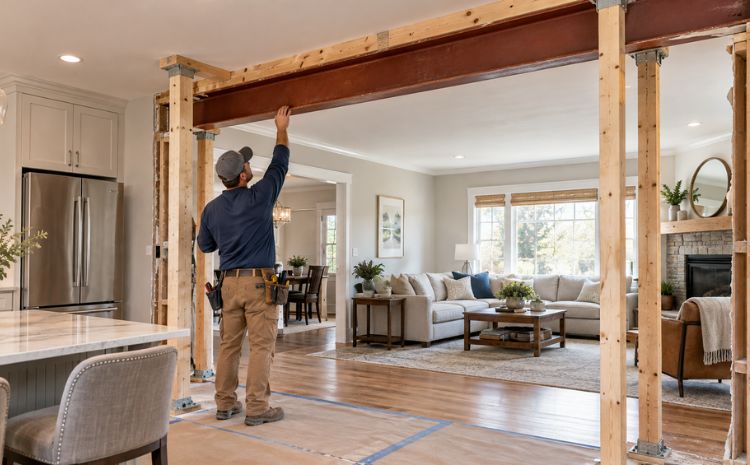
When the architecture itself is the bottleneck, openings fix what furniture can't. A widened cased opening — no wall fully removed, just a doorway grown into a generous archway — often delivers most of the connection at a fraction of full removal, and it's the move we recommend more than any other. Full wall removal, load-bearing or not, is everything we covered in Saturday's wall-removal cost guide: $1,500-$5,000 for partition walls, $5,000-$15,000+ when structure is involved. A pass-through or interior window splits the difference for walls full of plumbing that would be expensive to erase entirely.
Which opening is right is a sightline question before it's a structural one: stand where the cook stands, and ask what they should be able to see. Then stand where guests enter, and ask where the house invites them to go. The answers usually point at one specific wall — and it's not always the one people assume. (In pre-1978 homes, any of these are dust-making projects, so lead-safe practices ride along.)
The Honest Value Note
Connected main floors aren't just party infrastructure — they're the layout the market has voted for, which is why main-floor reworks sit where they do in the cost-versus-value data and why "open kitchen" leads so many buyer wish lists. But the best reason is Tuesday, not resale day: a main floor that flows hosts a family of four as well as it hosts a party of forty.
Frequently Asked Questions
How do I make my main floor better for entertaining?
Diagnose flow first: find the pinch point, fix the drink station placement, create sightlines to unused rooms, add landing surfaces. Then escalate only as needed — island seating and lighting before openings, widened openings before full wall removal.
Is open concept still worth it?
Connection is — full openness is optional. The current design direction favors connected-but-defined: big openings, sightlines, and cased thresholds rather than one undifferentiated room. You get the flow without losing the cozy.
What's the cheapest way to open up a floor plan?
A widened cased opening between the two rooms that matter most. It avoids beam work when the wall allows, reads as architecture rather than remodeling scar tissue, and routinely delivers most of the benefit of full removal.
Can this be done before Christmas?
The weekend and furniture tiers, obviously. A widened opening in a non-bearing wall, sometimes — it's a fast project when the wall cooperates. Structural openings belong to design season now, built in late winter, hosting-ready for next year — every year, the families who plan in November are the ones hosting in the after photo.
Host Better Next Year
Send us two photos — the kitchen from where you cook, and the main floor from where guests enter — and tell us where last year's party jammed. We'll tell you which tier fixes it and what it costs.
Covenant Contracting designs and remodels main floors across the St. Louis metro — Fenton, Wildwood, Ballwin, Chesterfield, St. Peters, Grover, Valley Park, and surrounding areas.
Request Your Free Layout Consultation →
Or call (314) 282-1991.