Fall Fire Pit Season: Patios and Fire Features for St. Louis Autumns
Our fall outdoor projects post last month made a claim worth expanding: the fire feature is the one outdoor project that's not merely possible in fall — it's perfectly timed for it. A fire pit finished in early October is ready for exactly the evenings it exists for: the 55-degree Friday nights, the post-soccer-game Saturdays, the Halloween week gatherings, the Thanksgiving weekend where everyone ends up outside with a blanket anyway.
St. Louis falls are genuinely the best outdoor season this region offers — mosquitoes gone, humidity broken, evenings crisp. The fire feature is the piece of hardware that extends your backyard's season by two full months on each end. Here's the complete guide: the options from $200 to $15,000+, what changes at each tier, the code and safety realities, and the timeline for flames before Halloween.
The Honest Hierarchy: Every Fire Feature Tier
The portable fire bowl: $150 – $800 (retail, not a construction project). The steel or cast-iron bowl from the hardware store. Zero commitment, moveable, genuinely fine for occasional use. We mention it for honesty: if your household will use a fire four times a year, buy this and enjoy it. The construction conversation starts when you notice you're using it every weekend and hating its smoke, its rust, and its wobble.
The kit fire pit on a proper base: $1,500 – $4,000 installed. Manufactured block kits (round or square) professionally set on a compacted gravel-and-paver base. A massive step up in permanence and looks from the bowl, achievable in a weekend of professional work, wood-burning by default. The right answer for tight budgets that still want "built."
The custom masonry wood-burning pit: $3,500 – $8,000. Real stone or block masonry, mortared, sized and styled to your patio, with a steel insert ring, proper drainage, and surrounding hardscape integration. This is where fire features start looking like landscape architecture instead of purchases.
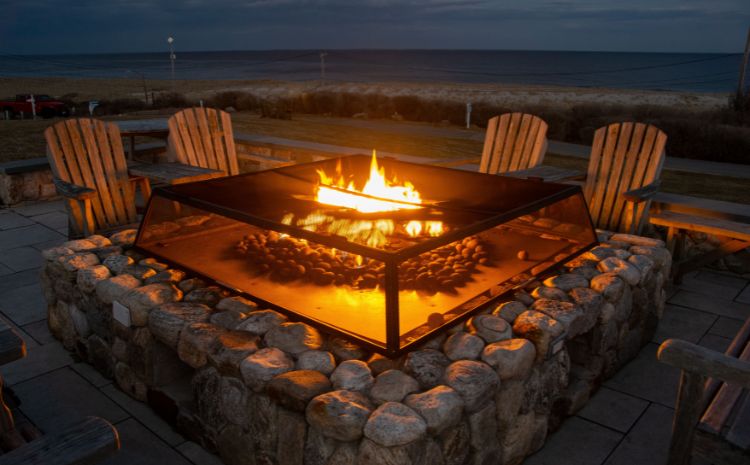
The built-in gas fire pit: $6,000 – $14,000. The tier we build most, and the one that changes usage patterns entirely. Custom masonry or steel-framed stone/stucco enclosure, gas burner system with lava rock or fire glass, key valve or electronic ignition, and a buried gas line from your home's supply. Instant on, zero smoke, zero embers, conversation-friendly, and — this is the underrated part — used 5-10x more often than wood versions, because lighting it takes four seconds instead of twenty minutes of tending. When clients ask "gas or wood?", our honest data point is: gas pits get used constantly; wood pits get used on occasions.
The fire table and linear feature tier: $4,000 – $12,000. Rectangular fire tables and linear trough burners integrated into patio walls or dining areas — the modern-aesthetic versions, all gas, same infrastructure as above with different shells.
The outdoor fireplace: $15,000 – $40,000+. Full masonry chimney fireplace — the estate piece. Directional heat, wind protection, genuine architecture. It anchors the premium tier of outdoor living projects and usually arrives as part of a larger patio/pavilion design (per our outdoor kitchen post, this is design-now-build-spring territory given its footings and masonry timeline).
Gas vs. Wood: The Real Trade
The eternal question, sorted honestly:
Choose wood if: the ritual is the point — the crackle, the smell, the marshmallows, the tending. Wood is cheaper to build, needs no gas line, and delivers the primal version of the experience. Accept: smoke management (and smoke-sensitive neighbors), ember watch, ash cleanup, wood storage, and the 20-minute startup that quietly reduces how often you bother.
Choose gas if: frequency is the point. Four-second ignition converts the fire pit from an event into a habit — the Tuesday-night-glass-of-wine amenity, not just the Saturday production. Accept: higher install cost (the gas line is $800-$2,500 of the budget depending on run length and meter capacity), no crackle (though lava rock pops gently), and marshmallows that toast without the campfire flavor romance.
The hybrid honest answer: several of our clients run a built-in gas pit at the patio and keep a $300 portable wood bowl at the yard's edge for bonfire nights. Total cost of admitting both things are true: $300.
Placement, Codes, and the Safety Stuff That's Actually Load-Bearing
Fire features are where backyard dreams meet municipal code, and St. Louis-area rules deserve respect:
Setbacks: Most metro municipalities require open flame features 10-25 feet from structures, property lines, and combustibles — and specific distances vary by suburb and by fuel type (gas features often get more lenient treatment than wood). We verify your municipality's requirements during design; this is also an HOA checkpoint in many subdivisions.
Overhead clearance: No tree canopy within the vertical clearance zone (typically 10+ feet for wood burning). That mature maple's October canopy is exactly what can't overhang a wood fire.
Surface: Fire features sit on non-combustible bases — which is why the fire pit conversation is usually a patio conversation. Setting a pit on grass or (worse) a wood deck is how insurance claims start. Composite decks and fire features do not mix without engineered protection, and mostly shouldn't mix at all.
Gas work is permitted work. Running a new gas line is licensed, permitted, inspected work — non-negotiable, and a reason the "installed" price of gas features is what it is. Anyone quoting a gas pit without permit line items is telling you how they build.
Wind and smoke sense: We site fire features accounting for prevailing wind and neighbor sightlines — the difference between the neighborhood loving your fire pit and passive-aggressive notes about smoke.
Burn regulations: Some municipalities restrict wood burning by air-quality day or season; gas features are exempt from burn bans in most local frameworks — a practical point for wood-vs-gas in tighter suburbs.
The Fire Pit as Anchor: Designing the Zone, Not the Object
The most common fire feature mistake isn't the pit — it's treating the pit as an object dropped into a yard instead of the anchor of a designed zone. The elements that make the difference:
The surround patio: a fire circle wants 18-21 feet of total patio diameter — pit plus 5-7 feet of clearance-and-chair space all around. (Paver patio pricing from our fall projects post applies: this zone is often a $8,000-$15,000 hardscape element.) Fall installation timing is ideal, per that post — base work and pavers proceed happily through October and November.
Seating that stays out: built-in seat walls ($2,000-$6,000 as part of the masonry) or quality all-weather furniture. Seat walls double as overflow seating for gatherings and define the zone architecturally.
Light layers: string lights overhead (the cedar-post framework is a $800-$2,000 add that transforms the space), path lighting to the zone, and the fire itself. The fall fire zone at twilight is the best room your house has, and it's outside.
Power and convenience: an outdoor outlet at the zone (phone speakers, crockpot of cider — real life), and a gas key or ignition switch located where you'd actually want it.
The Timeline: Flames Before Halloween
The September math, per feature tier:
- Kit pit + existing patio: 1-2 weeks from contract. October evenings: easily.
- Custom masonry wood pit + surround work: 3-5 weeks. Contract by end of September → mid-to-late October completion.
- Gas pit + new patio zone: 4-7 weeks (gas line permit and inspection included). Contract by mid-September → Halloween week flames, Thanksgiving certainty.
- Outdoor fireplace: spring project, designed this fall (footings, masonry timeline, and permits want the full runway — the design-now-build-March path from our fall projects post).
Fall scheduling reality: hardscape crews are in their best season (per last month's post), so these timelines are currently honest — they stretch after mid-October as the contract-to-freeze window narrows for the concrete-adjacent tiers.
Frequently Asked Questions
Do I need a permit for a fire pit in St. Louis suburbs?
For a portable bowl or simple kit pit: typically no permit, but setback and burn rules still apply. For gas features: yes — the gas line is permitted, inspected work. For masonry fireplaces: yes, including footing inspection. Municipal specifics vary; verifying them is part of our design step.
Can a fire pit go on my existing paver patio?
Often yes — pavers are non-combustible and the base is usually adequate for kit and masonry pits. We verify base compaction for heavier masonry, and for gas we plan the line route (sometimes under an existing patio via boring, sometimes around). On concrete patios: same story, easier.
How much does it cost to run the gas line?
Typically $800-$2,500 within the feature budget ranges above — driven by distance from your meter, trenching route complexity, and whether your meter/regulator has capacity (most do; we verify). Long runs across large yards can exceed this; the estimate makes it explicit either way.
Gas fire pit BTUs — what actually matters?
Typical built-in burners run 60,000-120,000 BTU. More isn't automatically better — flame height, wind exposure, and burner pattern matter more for the experience. A properly sized 90K burner in a wind-considered location outperforms a 150K flamethrower in a wind tunnel. This is a design detail we spec, not a number to shop.
Will a fire feature add home value?
Outdoor living investments show consistently strong buyer appeal in family-suburb markets, and fire features photograph like nothing else in a listing. Treat it like the bar in our basement series: the patio/outdoor zone carries the value math; the fire feature is what makes people fall in love. Build it for the two months of season it adds to your actual life; the resale charm is the bonus.
The Best Room in Fall Is Outside
The first genuinely crisp evening arrives in a few weeks. Whether your version is a $2,500 kit pit or the full gas-fired zone with seat walls and string lights, the September conversation gets you there before the season, not after it.
Covenant Contracting designs and builds outdoor living spaces across the St. Louis metro — Fenton, Wildwood, Ballwin, Chesterfield, St. Peters, Grover, Valley Park, and surrounding areas. Free consultations, honest tier guidance, real timelines.
Request Your Free Outdoor Consultation →
Or call (314) 282-1991.