Game Day Basement: Building the Ultimate Football Watch Space in St. Louis
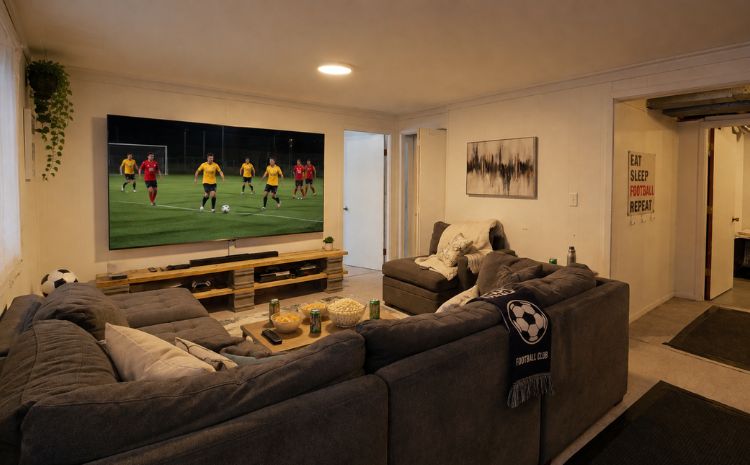
College football kicks off this weekend. The NFL follows in a week. And all across the St. Louis metro, families are about to rediscover — for the twentieth consecutive autumn — that the living room TV is too small, the seating fills up by kickoff of the noon game, and someone's watching Red Zone on a laptop at the kitchen counter.
If that scene sounds familiar, this post is for you. The game-day basement is one of the most requested projects we build, and the difference between the ones that become legendary and the ones that become storage rooms with a TV comes down to a handful of design decisions made before drywall.
This is the opening weekend edition of our fall basement series. Here's what actually makes a great watch space, what it costs honestly, and the timeline reality for having one before the playoffs.
What Separates Great Game-Day Basements From TVs in Basements
After building a lot of these, the pattern is clear. The great ones nail five things:
1. Sightlines from every seat — planned before framing. The cardinal rule: every seat sees the main screen without neck craning. This is a framing-stage decision, not a furniture decision — soffit locations, support pole treatment, and the media wall's position get locked early. The classic mistake is designing the room around square footage and then discovering the sectional's best layout faces a support pole. We design from the screen outward.
2. The multi-screen question, answered honestly. The triple-screen sports wall photographs incredibly and suits genuine multi-game watchers (one big center screen, two flanking verticals or horizontals for the other games and the fantasy scoreboard). Honest guidance: most families use the side screens six Sundays a year and should put that $2,500-$4,000 into a bigger main screen and better sound instead. Serious NFL Sunday households with regular crowds — the triple wall earns its cost. Know which household you are.
3. Layered seating capacity. Game-day crowds don't sit theater-style — they cluster, stand, drift to the bar, and pack in for the two-minute drill. The seating architecture that works: a deep sectional as the anchor (the prime seats), bar or counter seating behind it (the second row that doesn't feel second-class), and floor cushion/ottoman flexibility for the overflow. A well-designed 400 sq ft media zone comfortably handles 12-16 people this way; rows of recliners handle six.
4. The bar as the second gravity center. Every great watch space has two centers of gravity: the screen and the refreshments. When the bar/fridge zone lives in the media room (rather than up a flight of stairs), the host watches the game instead of playing waiter, and halftime happens without anyone missing the second-half kickoff. This doesn't require a full wet bar — a counter, beverage fridge, and cabinet run delivers 80% of the function at 30% of the cost. We're covering bar design in depth next week.
5. Sound you feel, contained politely. Two halves of one decision. In the room: a proper soundbar-plus-sub minimum, in-ceiling surround if budget allows — crowd noise in a Chiefs playoff game is half the experience. Above the room: insulation in the ceiling joists (rockwool or similar), solid-core door at the stairs, and suddenly the 3:25 game doesn't govern nap schedules upstairs. Sound isolation costs $1,500-$3,500 during construction and cannot be meaningfully retrofitted without opening the ceiling. This is the single most-thanked line item in our basement projects, reported by spouses.
The Design Details That Age Well
Warm, dimmable, layered lighting. Sports bars figured this out decades ago: you want dim-but-not-dark during the game, brighter for the pregame spread, warm everywhere. Recessed cans on zones, sconce or LED accent layers, everything dimmable. The single-switch ceiling grid look is what makes basements feel like basements.
Durable everything. This room will host nachos, spilled beers, cleats someone forgot to remove, and eventually teenagers. Luxury vinyl plank floors (waterproof, warm-toned), performance-fabric seating, quartz counters at the bar. The game-day basement is not the room for delicate finishes, and the good news is that durable and beautiful fully overlap now.
A bathroom, or at least the rough-in. The difference between guests trooping upstairs all afternoon and a self-contained entertaining floor. If the budget can't carry a finished bathroom now, spend the $1,500-$3,000 to rough the plumbing during construction — finishing it later is easy; adding plumbing under a finished floor later is demolition.
Team-neutral architecture, team-flexible decor. Build the room in warm neutrals and woods; express the fandom in swappable elements — framed jerseys, pillows, glassware, LED accent colors. Households divided between Mizzou and Illinois, or Chiefs and whoever, stay married. And the room survives decor evolution without a remodel.
What Game-Day Basements Cost in St. Louis
Working within the finished-basement cost framework we introduced earlier this month (full 2026 breakdown publishing next week), here's how the game-day configuration prices:
The core watch space — $45,000 to $70,000. Open finished space (500-700 sq ft), the designed media wall with proper power/conduit, layered lighting on dimmers, sound-isolated ceiling, LVP flooring, drywall ceilings with designed soffits. This tier delivers a legitimately excellent watch room without bar plumbing or bathroom.
The full game-day floor — $70,000 to $110,000. Everything above plus the bar zone (counter, beverage center, cabinetry — wet bar with sink at the upper range), a finished half or full bathroom, and typically a defined second zone (game table area, kids' zone) so the space serves the whole family all week.
The showpiece — $110,000 to $170,000+. The triple-screen wall done right, in-ceiling surround, full wet bar with dishwasher and ice maker, full bathroom, custom built-ins, ceiling design details, sometimes a golf simulator bay (add $15,000-$40,000 for the simulator itself, and plan the ceiling height — 10 feet minimum for full swings).
Electronics note: the screens and AV gear in the photos are often $8,000-$20,000 on top of construction. We build the infrastructure (conduit, power, blocking, acoustic prep) so your AV budget goes into gear, not into fishing wires through finished walls.
The Timeline Truth: This Season vs. Next Season
Here's the honest calendar, because this post publishes on opening weekend and hope springs eternal:
A basement started this week is not ready for this year's opening weekend — obviously — but it is realistically ready for the playoffs. The finished-basement timeline (10-18 weeks, per our August timing post) puts a Labor Day-week start at completion in late November to early January. Bowl season, NFL playoffs, and the Super Bowl in the new room: genuinely achievable. The Super Bowl party in a basement contracted after Halloween: not happening.
And if the decision waits until January — the classic "watching the playoffs at someone else's house" motivation spike — you're building in spring for a room whose season starts eight months later. Fine, but you've paid the same money and skipped a season.
The efficient move is the same one we described two weeks ago: walkthrough and design now, construction through the fall, first hosted game by the playoffs. The bar-design post next week and the full cost breakdown the week after will fill in the remaining decisions.
Frequently Asked Questions
What's the right main screen size for a basement media wall?
Bigger than instinct says, sized by seating distance: roughly 1 inch of diagonal per inch-and-a-half of viewing distance for sports. A sectional 10-11 feet from the wall wants an 85"+ screen. Projector-and-screen setups (100-120") shine in dedicated light-controlled rooms; we'll compare theaters vs. media walls properly in a few weeks.
Do we need a permit for a basement media room?
Yes — basement finishes involve framing, electrical, and often HVAC modification, all permitted work in St. Louis municipalities, plus egress review. Covered in our timing post earlier this month; we handle permitting on our projects.
Can the media wall go on an exterior foundation wall?
Yes, with proper furring, insulation, and moisture detailing behind it — standard basement construction done right. The moisture assessment comes first, always; that's next month's cornerstone post and the non-negotiable first step of every basement project we take.
Is a projector better than TVs for game day?
For a dedicated dark theater room, projectors win on sheer size. For the bright, social, lights-on game-day room described here, modern large-format TVs win — better brightness, no bulb maintenance, instant on. Many of our larger projects do both: TV media wall in the social zone, projector in a separate enclosed theater.
What about a golf simulator that doubles as the game screen?
Increasingly requested and genuinely great when the space allows: the simulator bay's impact screen doubles as a projector surface for game day. Requirements are specific — 10'+ ceilings, roughly 14' x 18' of dedicated bay space, and real budget. If your basement has the height, ask during the walkthrough; if it doesn't, no amount of wanting changes the ceiling.
Ready by the Playoffs — If the Conversation Starts Now
Opening weekend in the current living room, playoffs in the new basement — that's the honest offer on the table this week.
Covenant Contracting designs and finishes basements across the St. Louis metro — Fenton, Wildwood, Ballwin, Chesterfield, St. Peters, Grover, Valley Park, and surrounding areas. Free walkthrough consultations, honest timelines, real numbers.
Request Your Free Basement Consultation →
Or call (314) 282-1991.