Attic Insulation and Air Sealing: The Highest-ROI Project You'll Never See
Nobody tours guests through their attic. There's no before-and-after reveal, no pendant lights, no paint chips. And yet: dollar for dollar, air sealing and insulating your attic outperforms nearly everything else you can do to a house — it pays back in actual utility money every single month, makes every upstairs room more comfortable in both directions of the thermometer, and (as we covered two weeks ago) it's the primary cure for ice dams. It's the highest-ROI project you'll never see.
Here's what it costs, the sequence that makes it work, and why the crews who skip step one are selling you half a project.
Air Sealing First — Always First
Insulation gets the fame; air sealing does the work. Insulation slows heat conduction, but it does almost nothing against moving air — and a typical attic floor is riddled with pathways: wire and pipe penetrations, top plates, the chase around the chimney, recessed light housings, bath fan boxes, and that attic hatch with its proud quarter-inch gap. Warm air flows through those all winter like the house is exhaling money.
Blowing insulation over unsealed leaks is installing a sweater over an open window. The professional sequence, straight from the seal and insulate program playbook: seal the attic floor plane first (foam, caulk, gaskets, covers, dams around non-rated fixtures), then insulate on top of a tight lid. Ask any bidder where air sealing appears in their scope; the answer tells you which half of the project they sell.
Air sealing cost in St. Louis: $1,500 – $3,500 for a typical professional job — the number we cited in the ice dam post, and the best-spent slice of this entire budget.
Insulation: Depth, Type, and Cost
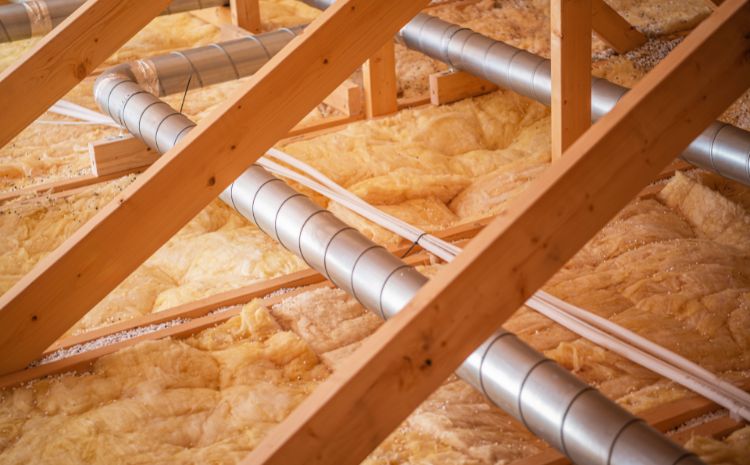
St. Louis sits in a climate zone where generous attic insulation depth pays in both seasons — the Rule Your Attic guidance frames it simply: if you can see your joists, you're under-insulated. Most metro attics we open were built to minimums that were modest then and inadequate now, often compressed or gapped besides.
Blown-in fiberglass or cellulose top-up: the standard move — even, seamless coverage over existing material to full depth. $1.50 – $3.50 per square foot, so a typical 1,200-1,500 sq ft attic runs $1,800 – $5,000 for insulation alone. Cellulose and fiberglass both perform well installed correctly; we'll give you the honest tradeoffs for your specific attic rather than a brand pitch.
The supporting cast that separates done from done right: soffit baffles so new depth doesn't choke ventilation (the ice-dam post's airflow rule), an insulated/gasketed hatch cover (the ceiling's biggest single hole), dams around the chimney and flues per fire clearances, and rerouting any bath fan that vents into the attic — the moisture crime from the ice dam post that also feeds the attic-mold problems in our moisture writing.
Complete project — air sealing + full insulation + details: typically $3,500 – $8,500 for most metro homes. (New corpus figures — flagged for sign-off.)
The Payback Case, Made Honestly
Three returns stack:
Utility money, monthly. Heating and cooling dominate home energy use, and the attic is usually the biggest fixable loss path. Typical results from proper seal-and-insulate work land in meaningful double-digit percentage reductions in heating/cooling costs for under-insulated homes — on metro utility bills, real four-figure savings over just a few winters, with the project commonly paying itself back in roughly 3-7 years and then just… continuing to pay. We'll estimate your specific case from your square footage and bills rather than promising a universal number.
Comfort, immediately. The upstairs that's cold in January and hot in July, the bonus room from last week's conversion — attic work is why those rooms join the rest of the house. Comfort doesn't appear on a payback spreadsheet, but it's the thing families mention first.
Winter damage avoided. The freeze-related loss research case from the ice dam post: this project is the cure for the melt-refreeze cycle. One prevented ice-dam winter can cover the entire budget.
When To Do It (Now) and When It Rides Along
Standalone: right now. Attic work is weather-flexible but pleasant-attic-dependent — October attics are workable; July attics are punishment; and every week earlier is a week of savings this winter.
As a rider: roof replacement (perfect timing for ventilation corrections), the bonus-room conversion, any bathroom project touching fan ducting, and before ceiling drywall in any renovation. If a bigger project is coming, sequence this into it — the access is already open and the crews are already there.
Frequently Asked Questions
How much does attic insulation cost?
St. Louis: blown-in top-ups run $1.50-$3.50/sq ft ($1,800-$5,000 for typical attics); professional air sealing $1,500-$3,500; complete seal-plus-insulate projects with baffles, hatch, and details typically $3,500-$8,500.
Is attic air sealing worth it?
It's the most valuable half of the project. Insulation over unsealed leaks underperforms permanently; sealing first is what the energy-efficiency guidance, the physics, and every honest contractor agree on.
How do I know if my attic needs more insulation?
Visible joists is the classic tell. Others: rooms that won't hold temperature, big heating bills, ice dams, and dramatic melt stripes on the roof after light snow — your roof literally maps your heat loss for you.
Does attic insulation help in summer too?
Yes — same physics, reversed. It slows attic heat (which can hit brutal temperatures under summer sun) from driving down into bedrooms, which is why the payback math counts cooling season too.
See Your Attic Honestly
One assessment: we photograph what's up there, map the leaks and the thin spots, check the fan ducting and ventilation, and hand you the seal-first scope with a real number and a real payback estimate for your house.
Covenant Contracting handles attic winterization, roofing, and remodeling across the St. Louis metro — Fenton, Wildwood, Ballwin, Chesterfield, St. Peters, Grover, Valley Park, and surrounding areas.
Request Your Free Attic Assessment →
Or call (314) 282-1991.